
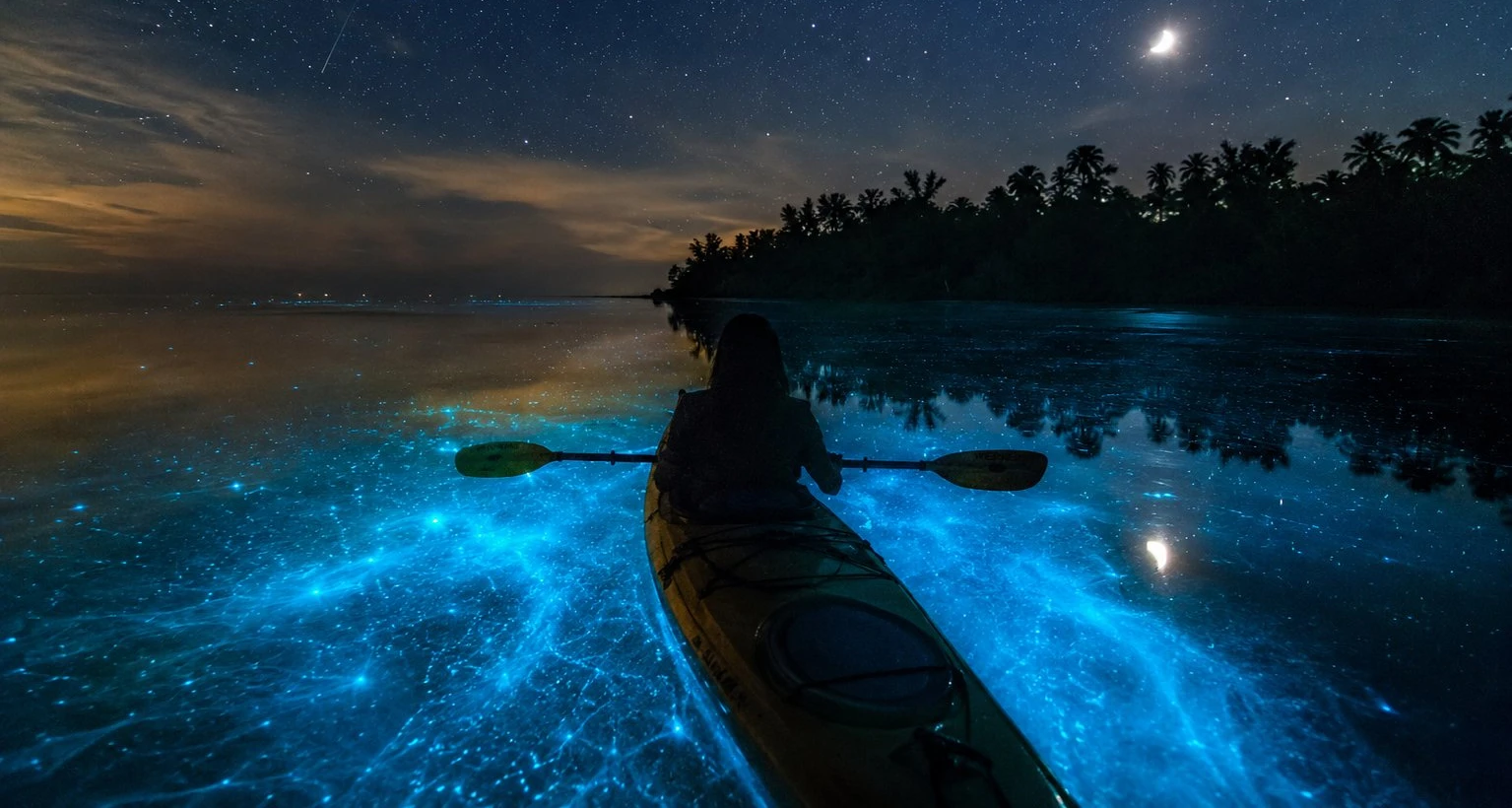
There's a moment, about ten minutes into a night kayak in Havelock, where everyone in the group goes quiet at the same time.
Nobody tells you to. It just happens. You dip your paddle in, pull it back out, and the water around the blade lights up — a streak of cold blue-green light, like you've just disturbed a galaxy that was hiding under the surface.
Then it fades. And you immediately do it again, because you need to know if that was real.
It was real. Here's what's actually happening, and why it only works some nights and not others.
What You're Actually Feeling
Forget every kayaking trip you've done before this. Daytime paddling is about effort — arms burning, sun on your back, racing your friend to the next point.
Night paddling in Havelock is the opposite. The water's flat and still, the only sound is your paddle dipping in and out, and the island behind you has gone almost completely dark except for a few resort lights. You're not really paddling to get anywhere. You're paddling to make the water react.
It's quiet in a way that's hard to describe to someone who hasn't sat in the dark on open water before. Not eerie-quiet. Held-breath-quiet. The kind where you find yourself talking less, and just trailing your hand in the water instead, watching the glow ripple off your fingers.
That's the whole experience, really. It's not an adrenaline activity. It's a slow, sensory one — and that's exactly why people come back from it more affected than they expected to be.
So What's Actually Glowing?
The light isn't magic, and it isn't algae in the way most people assume.
It's tiny marine organisms called dinoflagellates — microscopic plankton that live in the water in huge numbers. When they're physically disturbed (by your paddle, by a fish swimming past, by your hand dragging through the water), they emit a quick flash of blue-green light through a chemical reaction inside their own cells.
It's a defense mechanism, actually. Scientists think the flash is meant to startle or expose predators that are trying to eat the plankton — basically a tiny organism's version of a silent alarm. You, paddling through it, are accidentally setting off thousands of alarms at once, and the result looks like stardust.
The light only shows up when the water's disturbed, which is why a still, glassy patch of sea looks like nothing — until someone's paddle slices through it and it lights up like a struck match.
Why the Moon Decides Everything
This is the part almost nobody asks about before booking, and it's the single biggest factor in whether your night out is unforgettable or underwhelming.
Bioluminescence is faint. It's a small, specific glow — not a wash of light across the whole bay. Any extra ambient light competes with it and washes it out, and nothing produces more ambient light over open water than a full moon.
Book your kayak trip during a full moon and you'll see... some glow, if you look closely, on a calm patch where the moonlight isn't bouncing straight off the surface. Book it during a New Moon — when the sky is at its darkest — and the same water turns into something that looks computer-generated. The difference isn't subtle. It's night and day, literally.
This is exactly why we always ask your travel dates before confirming a night kayak booking. If you're visiting during a full moon week, we'll tell you honestly — go, but lower your expectations, or shift the activity to whichever night in your trip falls closest to the New Moon. A few days either side of it usually works.
It sounds like a small detail. It's the difference between "yeah it was nice" and the trip story you'll still be telling people a year later.
The Bit That Surprises People
The other thing nobody mentions: it's not just your paddle. Fish moving under the kayak set off the same reaction. So does a small wave breaking near the shore. So does another kayak's wake reaching yours, ten seconds after they pass.
You start watching for it everywhere. Someone in the group splashes their hand and the whole group leans toward the sound. A fish darts past the hull and lights up like a comet. It turns the whole paddle into this slow game of spot-the-glow, and somehow that's more memorable than if it had just been one big dramatic light show the whole way through.
The stars won't wait forever — and neither will the tide. If this is already on your list, stop dreaming and start paddling. Book your night kayaking experience in Havelock here